Impossible List - 15 October
How far I've come over the course of the last month in regards to the impossible list of goals I've set for myself.

A "40% chance of rain" doesn't mean there's a 40% chance it will rain where you are standing. It means that across a defined geographical area, for a defined time window, precipitation is expected to fall on roughly 40% of it.
There is a number on your phone right now. It might say 30%. It might say 60%. It is presented with the quiet confidence of a fact, a crisp percentage, sitting there next to a little cloud graphic, as though someone has done the maths and this is the result.
That number is, in any meaningful sense, made up.
Not maliciously. Not even carelessly. It's made up in the way that all predictions about chaotic systems are made up, with good intentions, sophisticated tools, and a fundamental inability to tell you what is actually going to happen.
The 40% chance of rain does not mean what you think it means.
Here's the thing meteorologists don't put on the front page of the app because it would cause a small existential crisis:
A "40% chance of rain" doesn't mean there's a 40% chance it will rain where you are standing. It means that across a defined geographical area, for a defined time window, precipitation is expected to fall on roughly 40% of it. Your back garden might be bone dry. The park three miles away is getting drenched. Congratulations, the forecast was correct.
This is called Probability of Precipitation, or PoP, and its official definition is so slippery that meteorologists themselves argue about it. The most commonly used version is:
PoP = Confidence × Coverage
So a 40% PoP could mean the forecaster is 80% confident it'll rain, but only over 50% of the area. Or it could mean they're 40% confident it'll rain everywhere. These are meaningfully different things. The app doesn't tell you which one it is. The app just says 40% and shows you a cloud.
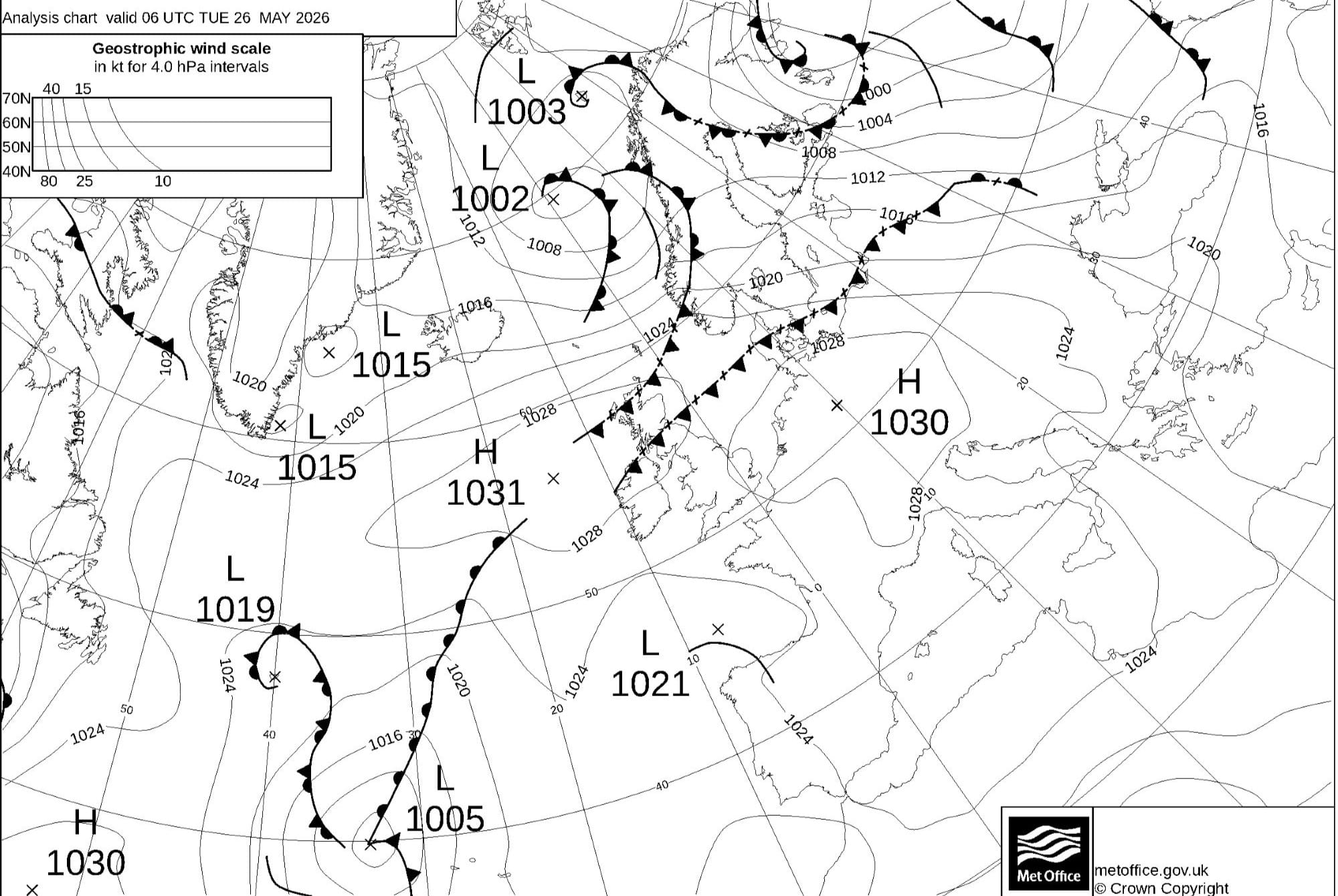
Modern weather forecasting runs on something called Numerical Weather Prediction, which is genuinely impressive and also completely insane in its ambition.
You take the current state of the atmosphere, temperature, pressure, humidity, wind speed, at thousands of points across the globe, and you feed it into a set of differential equations that describe how fluids behave. Then you run those equations forward in time.
The problem is that the atmosphere is a chaotic system. Not "chaotic" in the casual sense of "a bit messy." Chaotic in the strict mathematical sense: tiny differences in starting conditions produce wildly different outcomes over time. This is the butterfly effect, and it is not a metaphor. It is a genuine property of the equations.
The way forecasters deal with this is elegant and slightly disturbing: they run the model multiple times, each time with slightly different starting conditions, and see how the results cluster. If all fifty runs agree it'll rain, you get a high confidence forecast. If the runs scatter wildly, you get 40% and a shrug.
This is called ensemble forecasting. You are not getting a prediction. You are getting a probability distribution across possible futures. The app shows you one number extracted from that distribution and presents it as though someone just checked outside.
Here's where it gets interesting, because the problem isn't really the forecast. Meteorologists are extraordinarily good at their jobs. Modern five-day forecasts are more accurate than two-day forecasts were in the 1970s. The science is genuinely astonishing.
The problem is us.
Research consistently shows that people don't process probabilistic information correctly. When we see "30% chance of rain," most of us hear either "it probably won't rain" or "there's a real chance it'll rain", and which one depends almost entirely on our mood and what we were hoping to do that day.
There's also something called the "deterministic bias", our deep psychological preference for yes/no answers over probability distributions. We want to know if it will rain. We do not want to know about the ensemble spread of 500hPa geopotential height anomalies. The app gives us the former and pretends that's what the forecast actually says.
Some researchers have tried giving people the full probability distribution instead of a single number. The result? People found it confusing and trusted the forecast less, even when it was more accurate. We are not, it turns out, well-suited to living inside uncertainty.
There's another thing the apps don't tell you, which is that forecast accuracy falls off a cliff at around three days.
Day one: very good. Day two: solid. Day three: reasonable. Day four: we're basically doing informed guesswork. Day five onwards: vibes.
The useful lifetime of an atmospheric forecast is roughly ten days, after which the errors compound to the point where you might as well flip a coin. Your app will cheerfully show you the weather for two weeks from now with the same clean graphic and the same confident percentage, despite the fact that this is, scientifically, almost entirely fiction.
The forecast for a fortnight on Tuesday is not a forecast. It is a scenario.
None of this means weather forecasting is useless. It very much isn't. It means we're reading it wrong.
After all of this, the chaos, the uncertainty, the probabilistic hedging, the forecast is still, most of the time, roughly right.
The fact that we can model the behaviour of a planet-sized volume of gas, churning in complex fluid dynamics across thousands of kilometres, and tell you with reasonable confidence what tomorrow's weather will be like, that is, if you think about it for more than a second, completely extraordinary.
We're not bad at forecasting the weather. We're just bad at communicating and receiving uncertainty, which is, if you look around at most things happening in the world, something of a recurring theme.
It's going to rain on Saturday. Probably. Somewhere near you. Maybe.
Pack a jacket.